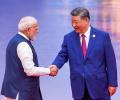
For India, China's Indian Ocean power projection, maritime domain awareness, dual-use ports, underwater surveillance, antisubmarinewarfare, naval exercises with Pakistan, pose considerable pressure, depleted India's strategic depth and marginalises Indian role, points out Srikanth Kondapalli.
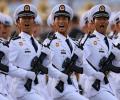
China's latest defence budget surges to $275 billion, fueling its ambitious military modernisation program and intensifying geopolitical dynamics in the region.

A combination of security pressure and rehabilitation efforts has significantly weakened Naxalism in India, leading to numerous surrenders and the elimination of key leaders.

The 'rescue' operation occurred within kilometres of Iran's underground tunnel complex at Isfahan, assessed by the IAEA and US intelligence as holding a substantial portion of the country's 60 per cent enriched uranium stockpile. Retired senior US military officers have highlighted that the mission's footprint -- hundreds of special operators, multiple heavy-lift aircraft deep inside Iran -- appears outsized for recovering a single airman. Prem Panicker continues his must read blog on the Iran War.

According to the Pentagon report, the PLA is creating options for dissuading, deterring, and defeating external intervention in the Indo-Pacific region.
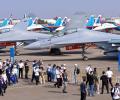
China has announced a 7.2 percent increase in its national defence budget, bringing the total to USD 249 billion for the year. This rise comes amidst China's ongoing efforts to modernize its armed forces, including the development of new warships and fighter jets. The budget increase, exceeding last year's 7.2 percent rise, reflects China's commitment to bolstering its military capabilities. Chinese Premier Li Qiang emphasized the importance of the Communist Party's leadership in guiding the military, with President Xi Jinping at the helm of the Central Military Commission. China's defence spending is now three times that of India's and is viewed by critics as a sign of the country's growing military ambitions.
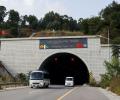
The announcement on expansion of CPEC was made following a meeting among Chinese Foreign Minister Wang Yi, his Pakistani counterpart Ishaq Dar and Afghanistan's Acting Foreign Minister Amir Khan Muttaqi in Beijing, according to a Pakistani readout.

The Information Support Force was regarded as the revised version of the PLA's Strategic Support Force, established in 2015 by the Chinese military to deal with space, cyber, political and electronic warfare to fight what was described as "informationised wars".
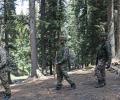
'It is typical of China's strategic deception of making virtue out of necessity,' observes Rup Narayan Das.
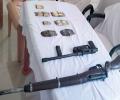
The Naxalites, 10 of whom are women, turned themselves in before senior officials of the state police and the Central Reserve Police Force (CRPF), he added.
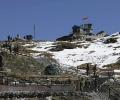
The government on Friday expressed deep concern over China constructing a road in the disputed Doklam area near Sikkim
She provided no evidence for the claim, which is at the complete variance with Bhutan's stated position.

Will China's new military reforms endanger Xi Jinping's rule?

China is expected to boost its nuclear arsenal after President Xi Jinping's remarks at the key Congress of the ruling Communist Party in Beijing for the first time that Beijing will establish strong strategic deterrence, experts have said.

In underlining the role of border villages as custodians of India's frontiers, New Delhi is following China's example in Tibet.

Sushma said the issue is due to the "tri-junction point that is between India, China and Bhutan" and that if Beijing unilaterally tries to change the status quo at the tri-junction, then it will pose a threat to New Delhi's security.

The briefing comes ahead of the parliament session beginning Monday.

We strongly urge India to take practical steps to correct its mistake, Wu said.

About 30 airports have been either built or under construction in Tibet and Xinjiang provinces which will boost China's civil and military infrastructure in the remote regions bordering India, the country's official media reported.

'No, the liberals haven't lost because there weren't any liberals in the fray to begin with.' 'What has happened is that left-wing orthodoxy has lost to right-wing orthodoxy.' 'That is at best a Pyrrhic victory for India,' argue Sonali Ranade and Sheilja Sharma.
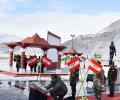
The Chinese authorities have been rapidly building defence infrastructure along the Line of Actual Control, indicating that they are preparing for a long period of tension with India, points out Jayadeva Ranade, the former senior RA&W officer and China expert.

Indian Army officers are convinced China is maintaining the pretence of dialogue and negotiations in order to create the opportunity to occupy more Indian territory. Senior Indian planners apprehend this might be a Chinese ploy to divert attention from Depsang, in Northern Ladakh, which might be China's actual target.

'There was a wrong policy of government during the Congress regime. They didn't construct roads up to the border which left a buffer zone of 3-4 km which China occupied. Construction of new villages isn't a new thing, it's all inherited from Congress'
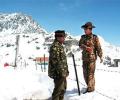
Ten days later, with the Indian Army in full control of the area where the incident took place, New Delhi has signalled a face-saver for Beijing.

The Tibetan nation still lives under the yoke of the Chinese Communist Party, and Beijing today has a guilty conscience; this creates a great uneasiness for Xi Jinping and his colleagues observes Claude Arpi.
China also hinted that India was objecting to its efforts to build the road in Donglang area of the Sikkim sector on behalf of Bhutan.
Today, the Ladakhis and Tibetans have been joined by the Sikhs, the Madrassis, the Garhwalis, the Rajputs, who are well trained psychologically and otherwise, to defend the nation, observes Claude Arpi.
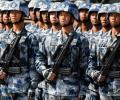
While China's nationalistic tabloid Global Times said India should be taught a 'bitter lesson', another official newspaper, China Daily, said India should look in the mirror.

'Chinese troops are not geared to fight Indian troops who are battle hardened and acclimatised and are far more hardy.'

'However, a lot of preparatory work would have to go in and China must be prepared to announce an end to the standoff by disengaging from the remaining areas along the LAC.'

'The separatist resurgence in Balochistan is thwarting Pakistan's plans to build CPEC projects to optimally utilise Balochistan's energy reserves,' points out Brigadier Gurmeet Kanwal (retd).

The Fujian was launched at a brief ceremony held at the Shanghai shipyard, the official media reported from the eastern metropolis.
Xi Jinping's recent actions in South Asia have amply demonstrated the disastrous impact of China's embrace, observes Jayadeva Ranade, the retired senior RA&W officer and China expert.
The military preparations underway show that the PLA may undertake operations this summer to achieve whatever objectives they could not achieve last May, asserts Jayadeva Ranade, the distinguished China expert and retired RA&W officer.
'The situation in Doklam has plateaued; militarily, the Chinese know they can do nothing here,' an Indian general tells Ajai Shukla.

The official cited it as an example of 'how the Chinese military is trying to resolve issues through dialogue mechanisms'.

At the border personnel meeting, China also accused the Indian side of damaging its road building equipment when a road laying party left its gear in Tuting in December last year following a protest by India.

'The supreme art of war is to subdue the enemy without fighting.' Former RA&W official Jayadeva Ranade explains what China's military reforms mean for the world.

China plans to divert about 200 billion cubic metres of water annually from the Brahmaputra at its highest point, namely the Great Bend, where it turns into India. China's Brahmaputra dam will severely impact India, warns former senior RA&W officer and China expert Jayadeva Ranade.

It will be interesting to see whether India-China border tensions figure during the deliberations of PLA deputies to the NPC and CPPCC, notes Jayadeva Ranade, the distinguished China expert and retired RA&W officer.
 © 2026 Rediff.com - Advertise with us - Disclaimer - Privacy Policy - Sitemap - Feedback - About us - Terms of use - Grievances